LangGraph Engine
One engine that runs a team of AI agents, where configuration decides what the team does
LangGraph Engine is a development project. A manager agent receives a brief, plans together with the person who sent it, asks counter-questions and hands the work to agents with specialised roles.
- One engine, many services. The same core can run quite different services, for example a creative agency, just by changing the configuration. The code stays the same.
- A person stays in control. The plan is approved before the work starts, a person can step in along the way, and the agents turn back to the manager when they need help.
- Any interface can drive it. The engine shows the progress of a run live and is built to work with different frontends. A first one is being built.
- Built from a written specification. The requirements are written down first, and the work is done in small steps, each tested before the next.
A learning project in my own time, not client work.
- Python
- LangGraph
- FastAPI
- PostgreSQL
- Claude API
Technical
Architecture & capabilities
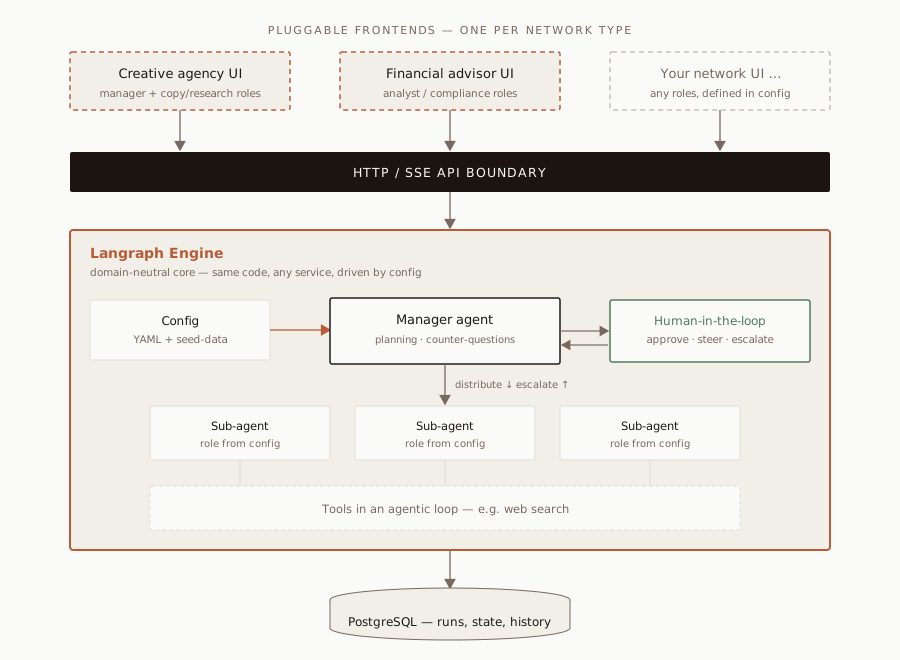
Architecture principles
- The engine is the product; frontends are pluggable. One core, delivered behind an HTTP/SSE boundary, driven by config — build/attach a different frontend per network type without touching the core.
- Domain-neutral by construction: agent roles, prompts, and seed-data live in configuration (YAML + seed), so a creative-agency network and a financial-advisor network are the same binary with different config.
- No vendor lock-in in persistence: PostgreSQL accessed via raw SQL/psycopg, no ORM or vendor SDK. Backend and frontend are separate repos — no monorepo, no shared code — coupled only by the API contract.
Capabilities
- Manager agent runs a planning dialogue, asks counter-questions, then distributes work to role-specialized sub-agents; sub-agents escalate back to the manager when they hit their limits.
- Human-in-the-loop at the decision points: approve a plan, steer mid-run, or handle an escalation.
- Tools in an agentic loop (e.g. web search) available to agents during execution.
- Live run state streamed over SSE; the reference frontend consumes it for new-run, run-list, run-detail, and live-status views.
Design decisions
| What | Why | Resolution |
|---|---|---|
| Persistence layer | An ORM/vendor SDK would add a dependency and abstraction the engine doesn't need | Raw SQL via psycopg against PostgreSQL — direct, inspectable, portable |
| Backend ↔ frontend coupling | A monorepo/shared package would tie the two release cycles together | Two separate repos, coupled only by the HTTP/SSE contract; frontend pinned to a Claude Design UI-spec |
| Per-domain behaviour | Forking the code per customer/network would multiply what has to be maintained | One domain-neutral core; behaviour comes from config (agent defs + seed-data) |
Evolved from an earlier CrewAI proof-of-concept (ai-creative-agency) into the current LangGraph-based, spec-driven rebuild.